
Boquete and the Chiriquí Highlands: A Tailor-Made Trip Guide
Boquete is a highland town in Chiriquí, at altitude, where the temperature sits around seventy to seventy-five degrees Fahrenheit all year. It is Panama’s coffee country and the base for climbing Volcán Barú, the highest point in the country at 3,475 meters, from whose summit you can see the Pacific and the Caribbean on one clear dry-season morning. Two nights is the working minimum, and you want a light jacket whatever the month.
Most Panama itineraries are built at sea level — the city, the Canal, the coast. The highlands are the counterweight, and they’re the part guests tend to talk about afterwards: cool air, coffee that people fly in for, cloud forest, and a volcano you can stand on top of before breakfast. Here’s what Boquete is actually like, month by month, and how we fit it into a longer trip.
The climate is the reason people stay
Boquete sits at altitude in a valley in Chiriquí, and the temperature barely moves all year: roughly seventy to seventy-five degrees Fahrenheit, with days in the mid-eighties and nights in the low seventies. After a few days on the Pacific coast, that first cool night is a genuine relief.
The valley has two personalities. In the dry months, December through April, the trade winds come through: windy, clearer, the cloud and mist pushed out of the valley. That’s the season for views, and it’s the season for the two-ocean view from the volcano.
From May through November you meet the bajareque — and this is the word to learn before you come. It isn’t a storm. It’s a fine, constant mist that drifts through the enclosed valley, more humidity than rain. You’ll want a light waterproof layer and you’ll be glad of it. What the bajareque gives you in return is rainbows: Boquete is the best place in Panama to see them, and in those months they turn up almost daily.
The practical version: bring a light jacket whatever the month. Travelers arrive from the city in shorts, having been told Panama is hot, and spend the first evening cold.
Volcán Barú, and what a sunrise up there really involves
Barú is the highest point in the country at 3,475 meters, and on a clear morning you can see the Pacific and the Caribbean at the same time — there is almost nowhere else in the world where you can stand in one spot and see two oceans.
Two ways up, and they suit different people.
By authorized four-by-four, up the Boquete side. Private vehicles are not permitted; it is authorized agencies only. You leave Boquete at four in the morning and you’re on the summit around six, in time for sunrise, with hot chocolate waiting at the top. It is a dirt road the whole way, so the drive is the least pleasant part of the day. Dress for it seriously: the summit can hit zero degrees Celsius. Every year someone goes up in a hoodie and regrets it.
Only authorized tour operators may drive up the Boquete side; private vehicles are not allowed. That has been the rule for a while — it isn’t something the roadworks introduced — and it may change in the near future, though no date has been set. Separately, at the time of writing the road itself is being repaired; once that work is done, going up in the green season should be easier than it is now.
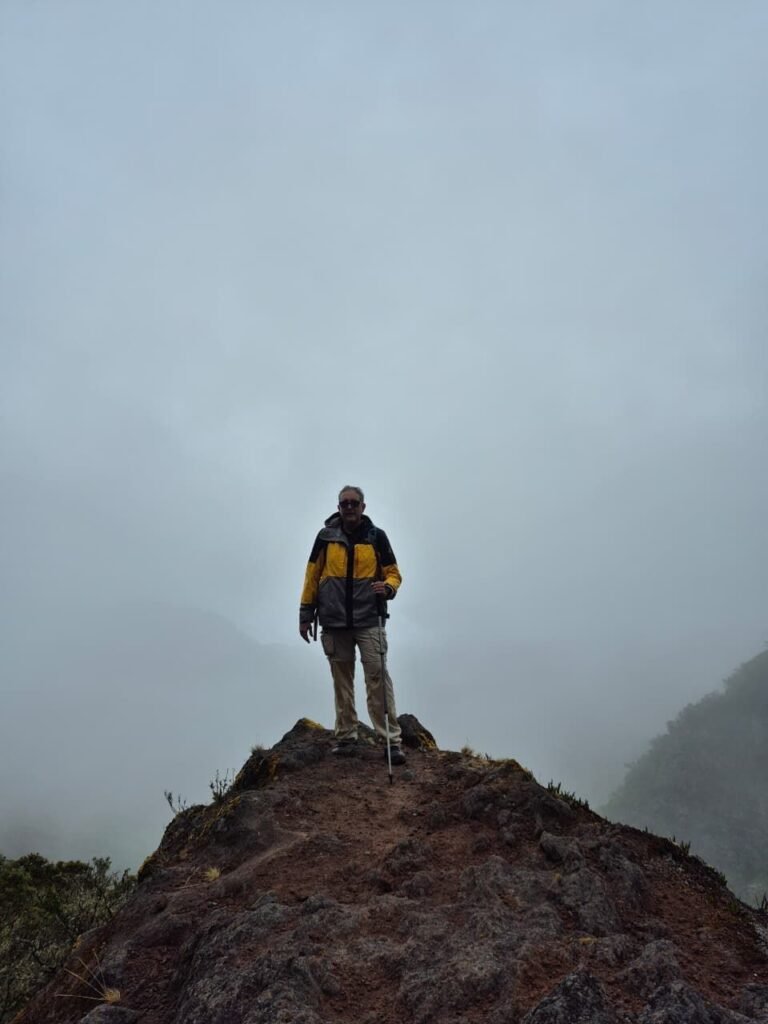
From the Volcán side. A jungle trail, seven to nine hours on foot, always with a guide. Some groups set off around midnight to reach the top at dawn. It is a real climb — and it is the side we recommend, because the route goes past a lodge and through cloud forest before it reaches the summit, which the Boquete road does not.
Three things to know before you plan around it:
- The two-ocean view is a dry-season proposition. December to April, at sunrise, is when it happens. In the green season the cloud cover makes it close to impossible.
- The climb works all year, from both sides. People have always gone up in the green season too. What the season changes is what you see from the top, not whether you can get up there.
- The green season has its own risks, and we say so plainly. While the road works last, rain can leave a vehicle stuck on the Boquete side; and on the Volcán side hypothermia is a real hazard up there. Both are reasons to go up with a guide who does this every week, and to pack for real cold.
Coffee, seriously
Boquete coffee is a reason to travel here on its own, not a gift-shop afterthought. The altitude, the volcanic soil and that same mist produce beans that win international auctions. Visiting a farm means walking the whole process — the plant, the picking, the washing, the drying, the roast, the cup.
We work with three, and we choose based on what you actually want:
- Don Pepe — the straightforward one. Shared tours at nine in the morning and two in the afternoon, covering the full process. Ideal if coffee is one stop in a busy day.
- Finca Elida — more specialized, for someone who already knows what they like and wants depth.
- Finca Lérida — the premium visit, and on the full tour you can be shown around by the farm’s owner.
All three can be done shared or privately — tell us which one sounds like you.
Birds, and the quetzal question
The cloud forest above Boquete is one of the reasons birders come to Panama at all — a country that consistently ranks in the global top ten, and the top five in Latin America, on eBird’s Global Big Day.
The bird people ask about is the resplendent quetzal. It comes down into the Boquete area on migration, and the window is December through April. Our answer is the only one we’re willing to give about any wild animal: in season, with an early start and a guide who knows the ground, your chances are good. Nobody can promise you a quetzal — but we’ve seen them there ourselves.
If birds are the point of your trip rather than a bonus, say so early — it changes the season we recommend and the guide we assign. Our birdwatching tour works the Canal watershed lowlands, and the highlands are the natural second half of a serious birding itinerary.
Where you stay
We’ve worked with the same place in Boquete for fifteen years, by now less a supplier relationship than a personal one. Cabins connected by garden paths and flowers, with a small river running behind the property — the sound of it at night is half the reason people book it again.
The cabins have full kitchens, so families can cook if they feel like it. Some are two-story with a loft upstairs, which works well with children; the smaller ones suit couples. Breakfast is included, served in a glass-walled restaurant in the middle of the property. There’s a spa on site — not part of the tour price, but worth knowing about after the volcano.
We deliberately leave dinner free. Boquete eats far better than a town its size has any right to — Italian, Peruvian, Mexican, Panamanian, gourmet, good pizza — and locking guests into a hotel dining room would be a waste of that. Your guide will point you at the right place for the night you’re having.
Put the highlands in your trip
Boquete works best as part of a longer route, not a detached side trip — and the season decides what the volcano will give you once you’re at the top. Send us your dates and we’ll tell you straight what the highlands will give you that week.
Build a tailor-made trip See the multi-day route
Travelling in the green season and set on the summit? Ask us on WhatsApp — we’ll tell you how the road is that week.
Getting there: fly, drive, or both
There are two sensible answers and they depend on how many days you have.
Drive up, fly back. What we do on the multi-day Best of Panama route, and our recommendation when the journey is part of the holiday. The road goes via Santa Clara on the Pacific coast, then Santa Fe de Veraguas — waterfalls, mountains, a national park most visitors have never heard of — then Playa Las Lajas, the longest beach in the country, and on to Boquete. Driven straight it’s over six hours; spread across the itinerary with those stops, it’s some of the best of the trip. You then fly home one-way from David and get a full day of daylight back.
Fly both ways. An hour to David, thirty-five minutes by road up to Boquete. The right call when the intermediate stops aren’t what you came for. No romance, but you’re drinking coffee on a terrace by lunchtime.
On the ground we work with a long-standing local partner for the mountain operations — people who know which road is passable this week.
How many days the highlands deserve
Two nights is the working minimum: one day for coffee and the town, one for the volcano or the cloud forest. Three and it stops being a checklist — a slow morning, a proper hike, a dinner you actually chose. Guests who budget one night almost always tell us afterwards they should have booked two.
Combining Boquete with the coast
The highlands pair naturally with the Caribbean side, and that’s how our longer routes are built: the city and the Canal first, Pacific coast and countryside on the way west, the highlands in the middle for the cool air, then down to the Caribbean to finish. Our multi-day itinerary guide shows what fits in four, six and nine days, and the nine-day route already has Boquete built into it.
Common questions
What is the best time of year to visit Boquete?
December through April is the dry season: windier, clearer skies, and the only realistic window for the two-ocean view from Volcán Barú and for quetzal sightings. May through November is green and quieter, with the bajareque mist and frequent rainbows. Bring a light waterproof layer either way — the highlands are cool all year.
What is bajareque?
A fine, constant mist that drifts through the Boquete valley in the green season. It is humidity rather than rainfall, it rarely stops you doing anything, and it is what makes Boquete the best place in Panama to see rainbows.
Can you drive to the top of Volcán Barú?
Yes, in an authorized four-by-four with an agency, and all year — the climb has always been possible in the green season as well as the dry one. Departure is at four in the morning to reach the summit for sunrise. Only authorized tour operators may drive up the Boquete side; private vehicles are not allowed, and that rule may change in the near future, with no date set. The road is also being repaired at the time of writing; once that is done, the green-season ascent should be easier.
Can you really see two oceans from Volcán Barú?
Yes, on a clear morning — the Pacific and the Caribbean at once, which is close to unique. In practice that means the dry season, December to April, at sunrise. In the green season cloud cover makes it very unlikely, and we would rather tell you that before you book than after.
How do you get from Panama City to Boquete?
Either drive, which takes over six hours direct but works beautifully spread over a multi-day route via Santa Clara, Santa Fe de Veraguas and Playa Las Lajas, or fly: one hour to David and thirty-five minutes by road. On our nine-day route we drive up and fly back, which saves a full day of daylight.
How many days should I spend in the Chiriquí highlands?
Two nights minimum — one day for coffee and the town, one for the volcano or the cloud forest. Three is better and lets the place slow down, which is rather the point of going up there.
Ready for the highlands? We build Boquete into tailor-made trips and into the nine-day route — coffee, cloud forest and the volcano, planned around the season. ★4.9 (337 reviews) — book via WhatsApp.